
If you’re building an AI product, security questions show up fast. A customer sends a vendor risk form. An enterprise asks about 24×7 monitoring. Your team starts logging more, but nobody’s sure what “good” looks like.
This is where the terms start flying around: SOC, SIEM, MDR. They’re related, but they’re not the same thing. And buying the wrong one (or buying them in the wrong order) can burn budget without lowering risk.
This guide breaks down SOC vs SIEM vs MDR, specifically for cybersecurity services for AI companies, with simple examples and a practical way to choose.
Why AI companies have different security pressure
AI teams tend to have a few “extra” risk magnets:
So when someone says “we need a SOC,” what they often mean is: “we need faster detection, clearer logs, and someone awake when things break.”
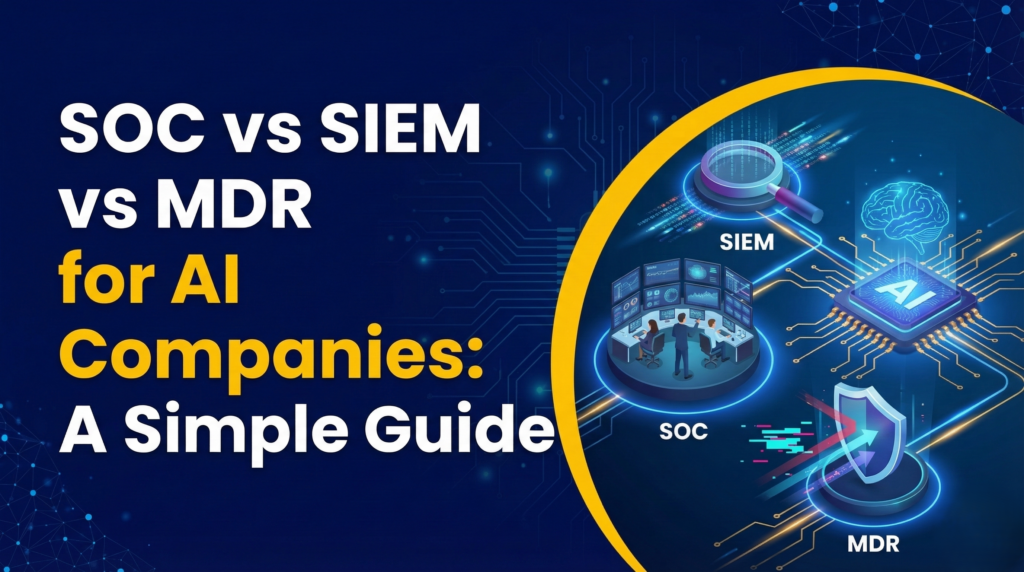
SOC vs SIEM vs MDR in plain English
What is a SOC?
A Security Operations Center (SOC) is a function, not a product. It’s the people + process that monitor alerts, investigate suspicious activity, and respond to incidents. A SOC might be internal (your team) or outsourced (managed SOC).
Think of SOC as: the security control room.
What is a SIEM?
A SIEM (Security Information and Event Management) is software that collects logs (cloud, endpoints, identity, apps), correlates events, and helps generate alerts and reports.
Think of SIEM as: the logging and alerting brain.
What is MDR?
MDR (Managed Detection and Response) is a managed service where a provider monitors your environment, investigates alerts, and helps contain threats. MDR often includes tooling (commonly EDR on endpoints and sometimes SIEM-like capabilities), plus a team that operates it.
Think of MDR as: a security team you rent, with tools included.
The quick comparison table
Item | What it is | Who runs it | Best for | Common blind spot |
SOC | People + process for monitoring and response | In-house team or managed provider | 24×7 security operations and incident handling | Without good log sources, it becomes guesswork |
SIEM | Platform for log collection, correlation, alerting | Your team or your provider | Central visibility, compliance reporting, investigations | Too noisy unless tuned, can get expensive at scale |
MDR | Managed monitoring + investigation + response | Provider’s analysts | Faster outcomes without hiring a full SOC | Coverage depends on what’s included (endpoints only vs full cloud + identity) |
What most AI companies actually need (based on stage)
Early stage AI startup (0–20 people)
You usually don’t need a full “classic SOC.” You need:
Scaling AI SaaS (20–150 people)
This is where SIEM starts to matter.
Selling to enterprise (150+ people or security reviews every week)
You’ll likely need a more formal setup:
A practical buying checklist (use this before you sign anything)
Step 1: List what must be monitored
For AI products, don’t stop at endpoints. Include:
Step 2: Decide the “coverage hours” you truly need
Be honest:
Step 3: Pick the operating model
Use this quick rule:
Step 4: Ask these vendor questions (copy-paste)
Step 5: Run a 14-day proof, not a slide deck
A good trial shows:
Where India-specific requirements come into play
If you operate in India or process personal data of Indian users, keep an eye on privacy and security obligations and timelines.
This is exactly why SIEM conversations come up early in India: logging, retention, and evidence become board-level topics once compliance and enterprise deals enter the picture.
Common mistakes AI teams make with SOC, SIEM, and MDR
How Imperium Digital fits into this for AI companies
If you want a single partner to cover the basics plus ongoing monitoring, Imperium Digital positions its Security Services around common building blocks like IAM, data encryption, security awareness training, firewall and network security, cloud security, endpoint security, zero trust, and DDoS protection.
For endpoint-focused detection and response, Imperium also offers Managed Endpoint Security Services and lists vendor technologies such as Microsoft, Fortinet, Palo Alto Networks, SentinelOne, and Trellix as part of that approach.
If you’re evaluating options, they also mention 24×7 phone and email support during evaluation, and their Security Services page promotes a “free quote in 30 minutes.”
FAQs
1) Do I need a SOC if I already have MDR?
Not necessarily. MDR can function like an outsourced SOC for detection and first response, as long as coverage, SLAs, and responsibilities are clearly defined.
2) Is a SIEM required for SOC 2 or ISO 27001?
Not strictly “required,” but central logging and evidence are. A SIEM often becomes the easiest way to meet monitoring and audit-proof reporting needs.
3) What should AI companies log first?
Start with identity events (SSO, MFA, admin role changes), cloud audit logs, endpoint security events, and your API gateway logs (auth failures, rate-limit triggers, unusual spikes).
4) How long should we retain logs in India?
Many organizations align with CERT-In directions that reference maintaining ICT logs for a rolling 180 days in India, depending on applicability. (CERT-In)
5) Can SOC or MDR help with prompt injection and model abuse?
Yes, if you treat it like a detection problem: log risky prompts and tool calls, alert on suspicious patterns, and connect those app signals to your broader monitoring.
Conclusion
SOC is the team and process. SIEM is the log and alert platform. MDR is the managed service that can run detection and response for you. For most AI companies, the best answer is a mix, chosen in the right order based on stage and sales pressure.
If you want help deciding what you need right now (and what can wait), talk to Imperium Digital’s team and ask for a scoped plan around your AI stack, coverage hours, and compliance requirements.
Delivering seamless connectivity, secure networks, and innovative IT solutions to drive efficiency, reliability, and growth in the digital era.

Copyright © 2025 Imperium Digital Network. Pvt. Ltd. All rights reserved. | Privacy Policy | Terms & Conditions.