
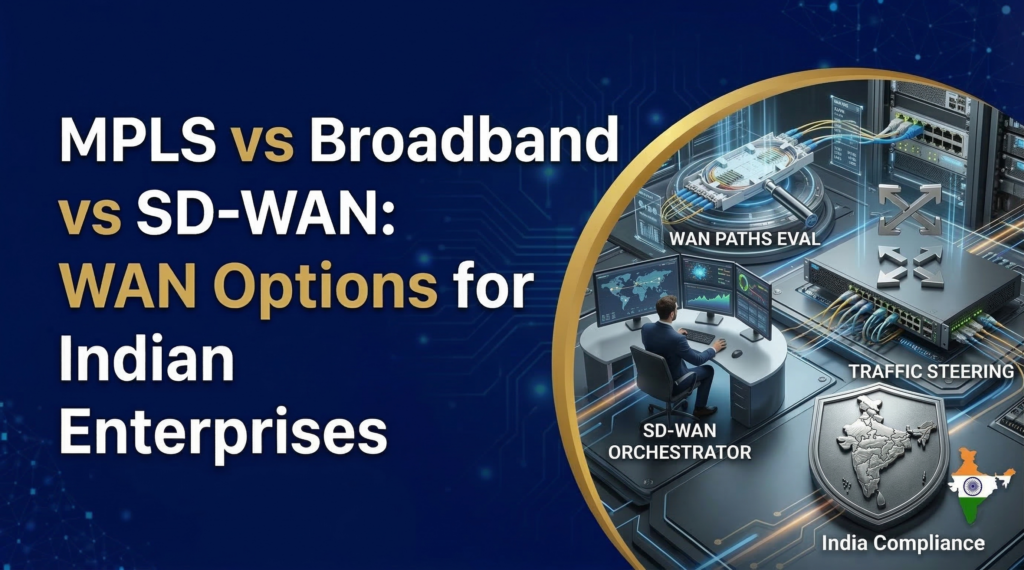
If you’re connecting multiple offices across India, your WAN choice decides how stable your day-to-day work feels. Slow ERP screens, choppy calls, patchy VPN logins, and video meetings that freeze are usually WAN problems, not “just the internet”. That’s why most enterprise networking solutions start with one simple question: should you go with MPLS, broadband, SD-WAN, or a mix?
In India, the answer isn’t the same for every company. ISP quality can change street by street, fiber availability varies by city, and some locations still depend on last-mile links that behave differently during peak hours. The right WAN option is the one that matches your apps, your uptime expectations, and your branch realities.
This guide compares MPLS vs broadband vs SD-WAN in a practical way, so you can pick what fits, and implement it without surprises.
What these three options really mean (without the jargon)
MPLS is a private network service delivered by a provider. You typically get predictable routing, defined SLAs, and controlled performance between your locations. It’s often chosen when the business needs consistency and the sites are stable, like HQ to key branches, factories, or a data center.
Broadband (fiber, leased broadband, or business internet) is public internet access. It’s usually faster to deploy and cheaper per Mbps, but performance can vary depending on the provider, routing, contention, and last-mile conditions. In many Indian cities it’s excellent, but in some areas it can be inconsistent, especially when you rely on just one link.
SD-WAN is an overlay that uses software policies to steer traffic across one or more links (MPLS, broadband, 4G/5G). It doesn’t magically fix a bad link, but it can use multiple links intelligently, route critical traffic on the better path, and fail over faster than traditional setups. It can also simplify how you manage many branches.
Quick comparison table for Indian enterprise WAN planning
|
Factor |
MPLS |
Broadband |
SD-WAN (with 2+ links) |
|
Typical performance |
Predictable |
Varies by ISP and area |
Can be very stable if links are decent |
|
SLA and support |
Usually strong |
Mixed, depends on plan/provider |
Depends on underlay + vendor support |
|
Deployment speed |
Medium to slow |
Fast in most cities |
Medium (needs design + rollout) |
|
Cost approach |
Higher per Mbps |
Lower per Mbps |
Device/licensing + multiple links |
|
Best for |
Critical sites, steady workloads |
Cost-focused sites, fast rollout |
Multi-branch control, hybrid designs |
|
Common risk |
Cost and long lead times |
Fluctuations, routing changes |
Poor results if links are weak or misconfigured |
When MPLS makes sense (and when it doesn’t)
MPLS is still a solid choice when you have a small set of sites that must stay predictable. Examples include a head office connecting to a data center, a plant running latency-sensitive systems, or a shared services center handling voice and critical back-end access.
It also helps when you want one provider to own the end-to-end path and offer clearer accountability. If you’ve ever dealt with “it’s not our problem” between two ISPs, you know why this matters.
Where MPLS starts to feel heavy is cost and lead time. Adding bandwidth can be expensive. New circuit provisioning can take time. And if you have 30, 60, or 200 branches, managing change requests through a provider can slow you down.
When broadband is enough (and how to make it safer)
Broadband can work very well in India for many branches, especially when your apps are cloud-first (Microsoft 365, Google Workspace, CRM, HRMS) and you don’t need private routing between every site.
The key is to treat broadband like a business link, not a home plan. Pick business-grade plans with better support, request proper documentation (static IP if needed, SLA terms, escalation matrix), and test performance during peak hours. In some locations, two different providers on two different physical paths is far more valuable than “one premium link”.
Broadband becomes risky when you use it as the only link for voice, POS transactions, or central ERP access in a branch that can’t tolerate downtime. In those cases, a dual-link design usually beats a single better link.
Where SD-WAN fits best for Indian enterprises
SD-WAN works best when you have multiple sites and mixed application needs. It’s especially useful when you want to combine links, like MPLS plus broadband, or dual broadband, or broadband plus 4G/5G, and then control which traffic goes where.
A common Indian enterprise pattern looks like this: keep MPLS for a few critical hubs or plants, use business broadband for most branches, then add SD-WAN to steer voice and ERP traffic to the best available path while sending non-critical traffic on the cheaper link. This reduces complaints from users without forcing every site onto a costly private circuit.
SD-WAN is also helpful for rollout consistency. If you’ve ever seen 10 branches configured 10 different ways over time, SD-WAN templates and central policies can reduce that mess and make troubleshooting faster.
A practical selection checklist (written as a single flow you can follow)
Start by listing your “must not fail” applications, for example POS, VoIP, ERP, plant systems, VPN access, or video meetings, and write down what failure looks like (slow is fine vs downtime is not fine). Next, map your branches into tiers, like Tier 1 (HQ, data center, plant), Tier 2 (large revenue branches), Tier 3 (small offices). Then check underlay feasibility per site: which ISPs can provide fiber, what the lead time is, and whether a second provider can enter the building using a different path. After that, decide the baseline link plan: for Tier 1 sites, consider MPLS plus broadband; for Tier 2 and Tier 3, consider dual broadband, or broadband plus 4G/5G backup where fiber is weak. Now choose the control layer: if you have many sites and mixed apps, SD-WAN is often worth it for policy routing, fast failover, and visibility; if you have only a few sites and stable needs, traditional routing with strong circuits may be enough. Finally, plan for testing and monitoring: define acceptance tests (latency, jitter, packet loss, failover timing) and make sure you’ll monitor links and application experience after go-live.
Real-world examples (so it doesn’t stay theoretical)
If you run a retail chain with 40 stores, broadband-only often looks attractive until the first weekend of payment issues. A stronger setup is dual broadband with SD-WAN policies, where payment and POS traffic get priority and failover is automatic, while guest WiFi stays capped and separated.
If you run a manufacturing group with 3 plants and 12 sales offices, MPLS to the plants (plus backup internet) can keep shop-floor systems stable, while sales offices can run on broadband with SD-WAN for secure access to central apps.
If you’re SaaS-heavy and most work happens in cloud apps, broadband-first is usually fine, but you still need segmentation, firewall rules, and backup links for key locations, because “cloud-first” still depends on last-mile stability.
Implementation notes that save time and reduce downtime
Don’t migrate WAN without a clear IP plan and traffic segregation. Even if your WAN is perfect, a flat LAN can cause broadcast noise, security gaps, and troubleshooting pain. Define VLANs, routing boundaries, and firewall zones early, and document them.
Plan failover properly. Many networks “have backup links” that don’t actually work when needed because DNS, routing, or NAT policies break during failover. Your acceptance test should include pulling the primary link, timing the recovery, checking voice quality, and validating access to the apps people use most.
Finally, keep your operational ownership clear. Decide who handles ISP escalation, who manages SD-WAN policies, and what the response time expectations are. This is where a good partner can help, especially if you’re rolling out across many Indian cities.
FAQs
Is MPLS still worth it in 2026 for Indian enterprises?
Yes, for high-criticality sites where predictable performance and provider accountability matter, but many companies now combine MPLS with broadband and SD-WAN.
Can SD-WAN replace MPLS completely?
Sometimes, but not always. SD-WAN works best with two or more decent links, and some sites still benefit from MPLS as one of those links.
Is broadband reliable enough for VoIP and video meetings?
It can be, especially in metros with good fiber, but reliability improves a lot when you add a second link and prioritize real-time traffic.
How many WAN links should a branch office have?
For most revenue-impacting branches, two links is the practical minimum (two ISPs or one ISP plus 4G/5G backup).
How long does a WAN migration typically take?
A small rollout can take a few weeks. Multi-branch rollouts often take a few months depending on circuit lead times, site readiness, and testing.
Conclusion
MPLS, broadband, and SD-WAN aren’t “either-or” choices anymore. Most Indian enterprises get the best result from a hybrid plan: predictable links where it matters, lower-cost bandwidth where it’s fine, and SD-WAN policies to keep performance steady across the lot. If you want this designed cleanly from the start, Imperium Digital can help you plan the right mix, document it properly, and implement it with testing so branches don’t feel the change as “downtime”.
Delivering seamless connectivity, secure networks, and innovative IT solutions to drive efficiency, reliability, and growth in the digital era.

Copyright © 2025 Imperium Digital Network. Pvt. Ltd. All rights reserved. | Privacy Policy | Terms & Conditions.